Vehicle dynamics, simulation software, and control for autonomous vehicles
I connect physical vehicle behaviour with planning and control, to improve how autonomous vehicles track their paths, including at high speed and in aggressive manoeuvres. I build vehicle dynamics software, learn and correct the gap between simulation and the real vehicle, identify how actuators respond and control them, and develop optimisation-based trajectory tracking. Ph.D., IIT Kharagpur. Now at Swaayatt Robots.
A detailed project portfolio, including technical results and visualisations, is being developed.
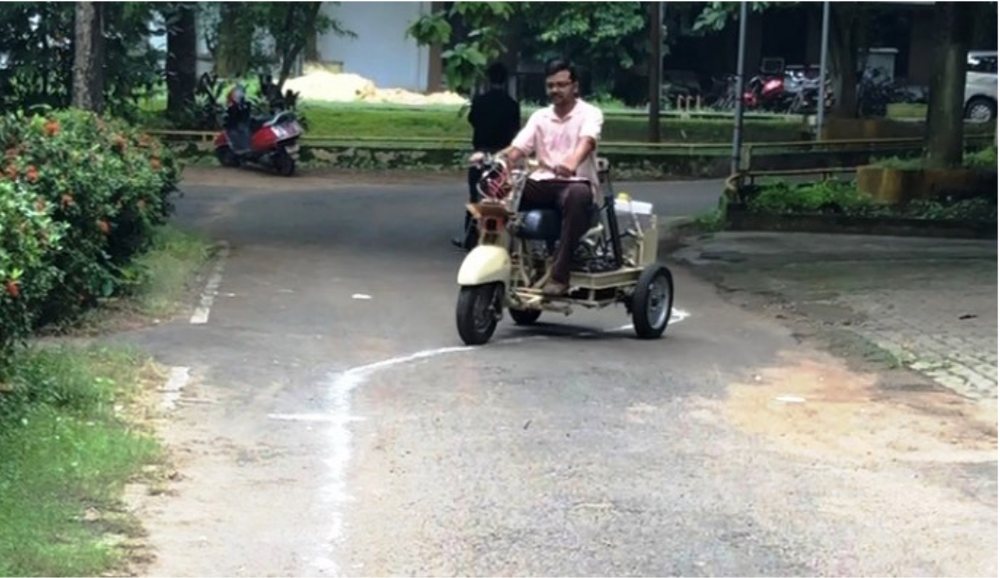
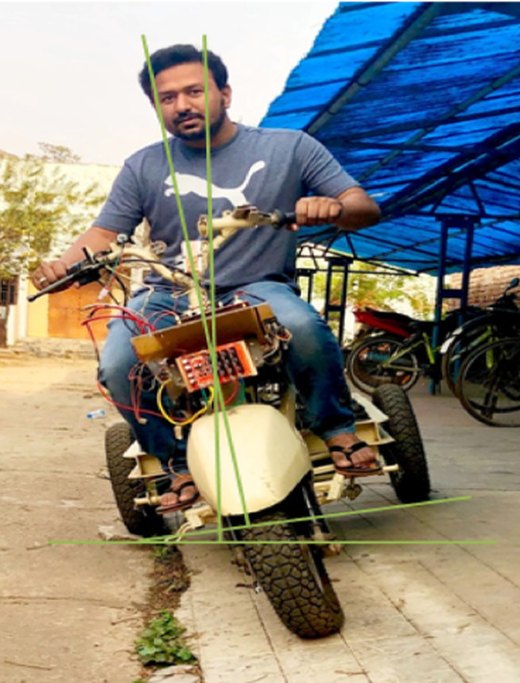
Lane-change test on the IIT Kharagpur tilting three-wheeler prototype, built by J. Sindha. My Ph.D. work modelled this vehicle and developed its rollover control in simulation.
How I can contribute
From physics to real-world behaviour
My experience brings together coupled multibody vehicle dynamics modelling, system identification, and offline and real-time vehicle parameter estimation. Using experimental data and machine learning, I can estimate and compensate for differences between simulation and real-vehicle behaviour. These capabilities provide a foundation for developing accurate vehicle models for trajectory tracking and control.
How actuators respond
I identify how actuation systems respond to reference commands across driving scenarios, and use that to develop lower-level control that adapts to the actual, varying sample rate of vehicle data, updating model and controller parameters in real time.
Trajectory tracking at high speed and in aggressive manoeuvres
In the higher-level control layer, I use optimisation and control to improve trajectory tracking at high speed and in aggressive manoeuvres, within safety limits such as rollover stability. Some of this is computed offline, for example optimal settings stored as lookup tables, and some is solved online while the vehicle runs.
Selected projects
Project visuals and post-processing results are being added. Click an image to enlarge.
Learning-based vehicle dynamics model correction
Swaayatt Robots
Problem: a vehicle dynamics simulation never matches the real vehicle exactly, and that gap limits how far simulation can be trusted for control design and testing.
Approach: compare the simulation with measured vehicle data to quantify the error, learn that error with machine-learning models, and compensate the simulation with the selected model. The work covered the data acquisition strategy, data extraction and analysis, the simulation, model training and compensation.
Model selection: I compared multiple model types across parameter settings and input normalisation techniques and, for neural networks, across numbers of neurons and layers. This was an extensive comparison; the result reported is for the selected model.
Result: the trained models reach R² above 0.99 in learning the error in simulated position (X, Y) and heading.
Physics-based vehicle multibody dynamics simulation model
Swaayatt Robots · In development
A simulation model that applies my vehicle dynamics experience, with parameter estimation from experimental data layered over the basic simulation model. It builds on Simscape Multibody vehicle modelling and experimental validation from my Ph.D., and on suspension kinematics and ride modelling from Pravaig Dynamics.
Goes beyond a planar bicycle model by including load transfer, roll and pitch, suspension kinematics, nonlinear tyres and, as integration proceeds, identified actuator dynamics.
Modular C++17 four-wheel framework: longitudinal, lateral, yaw and vertical dynamics, Pacejka tyres, roll and pitch.
ROS1/Gazebo vehicle built from component meshes with geometric and inertial properties, being integrated with physics-based dynamics and actuator models.
Parameter estimation, in development: roll and pitch behaviour through the roll centres at front and rear and the pitch centre, derived from suspension geometry with approximations where full geometry is unavailable. Planned instrumentation: coilover travel sensors and IMUs near the wheels, correlated with steering, speed and sprung-mass roll and pitch. Data-driven methods can reduce the need to estimate some parameters explicitly.
Offline and real-time parameter estimation, with Load Transfer Ratio and Stability Margin metrics that include suspension kinematics and road slope.
System identification and control of actuators
Swaayatt Robots · Next: gain-scheduled PID and LPV-MPC
Steering and braking actuator dynamics identified from experimental data, with C++ implementations, second-order Butterworth filtering and tuned control parameters. The identified discrete-time models are converted in real time to match the actual working frequency of the vehicle data. PID and Model Predictive Control are tuned and evaluated today. Gain-scheduled PID and LPV-MPC are the next step. The identified models are what make model-based control, such as MPC, possible on the steering and braking actuators.
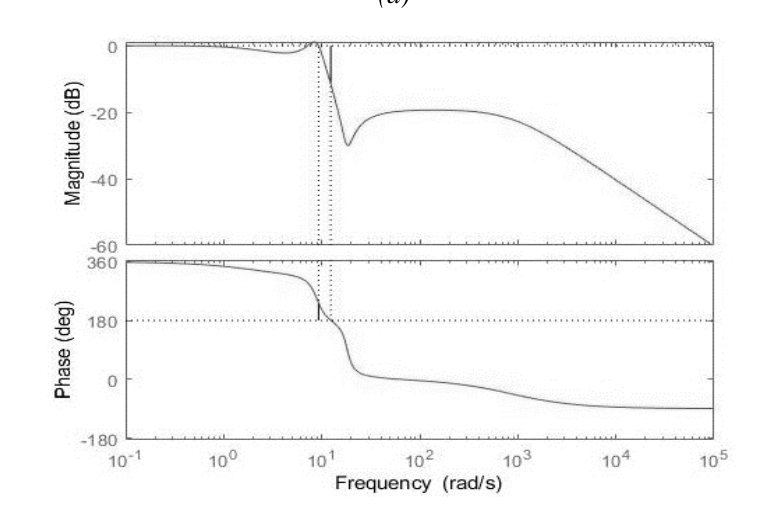
Groundwork: in my Ph.D. I identified hydraulic tilt and electric steering actuators, designed PID loops checked by frequency response, and built a speed- and steering-dependent gain lookup table, which is gain scheduling in practice.
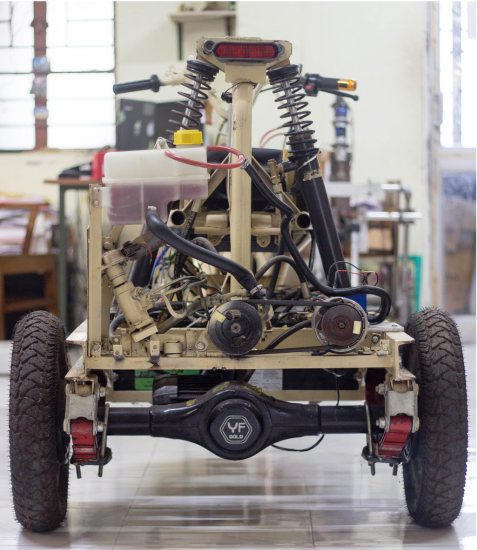
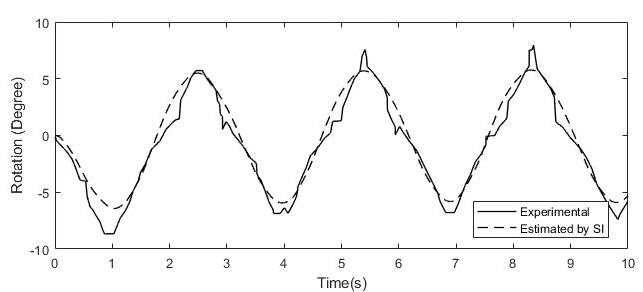
Hydraulic tilt actuation system on the prototype. Ph.D. thesis, IIT Kharagpur.Tilt actuator: measured response and identified model. Ph.D. thesis, IIT Kharagpur.Closed-loop frequency response of the active steering system. Ph.D. thesis, IIT Kharagpur.
Suspension kinematics software for hard-point optimisation
Pravaig Dynamics
A custom double-wishbone tool that calculates linkage motion under heave, droop, steer and roll, with 3D visualisation of component movement. Hard points were evaluated on camber, toe, roll-centre migration, track change, scrub radius and motion ratios.
Quarter-car suspension model and coilover optimisation
Pravaig Dynamics
A quarter-car model built for ride studies, from which I selected the coilover specifications using optimisation techniques. The optimisation gave a Pareto front of spring stiffness and damping coefficient that meets the target sprung-mass natural frequency and the required suspension travel (tyre rebound and compression). Half-car models alongside it supported ride-height and rake evaluation and sprung-mass natural-frequency analysis.
Multibody Dynamics Model of an Active Tilting Three-Wheeler
Ph.D., IIT Kharagpur
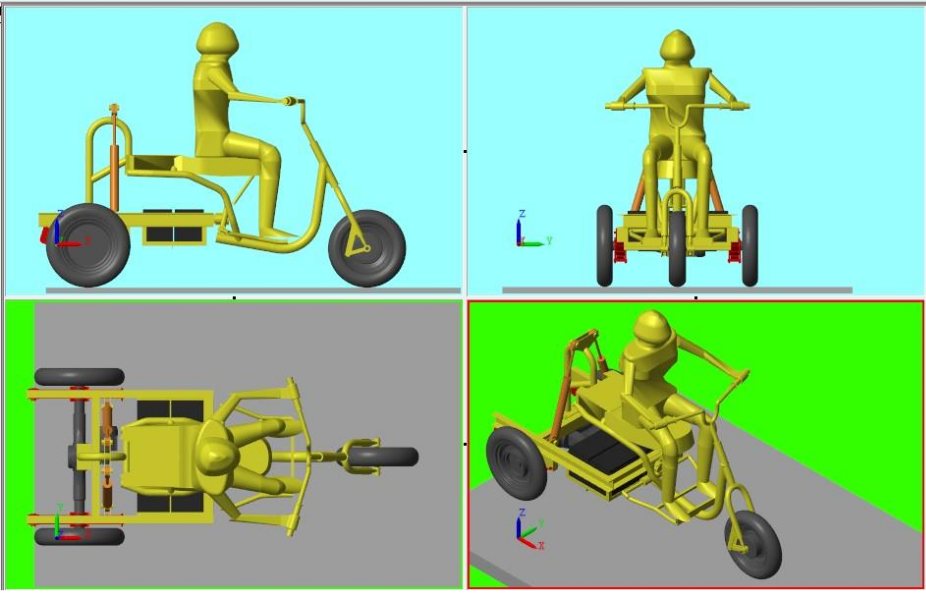
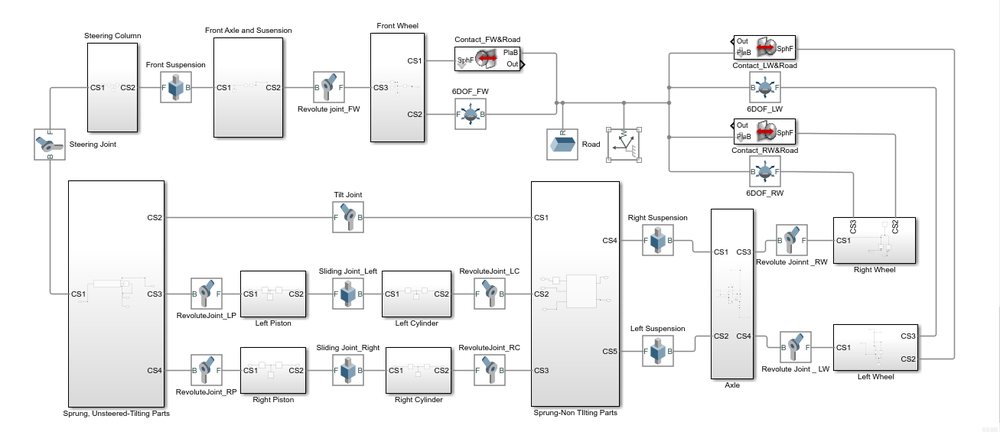
A 14-DoF Simscape Multibody model built from CAD, with joints, sensors, actuators and the tilting mechanism, representing the mechanical configuration and coupled motion of the active tilting three-wheeler.
Simscape Multibody model of the tilting three-wheeler. Ph.D. thesis, IIT Kharagpur.Block diagram of the multibody model. Ph.D. thesis, IIT Kharagpur.
Integrated Vehicle Dynamics Modelling and Validation
Ph.D., IIT Kharagpur
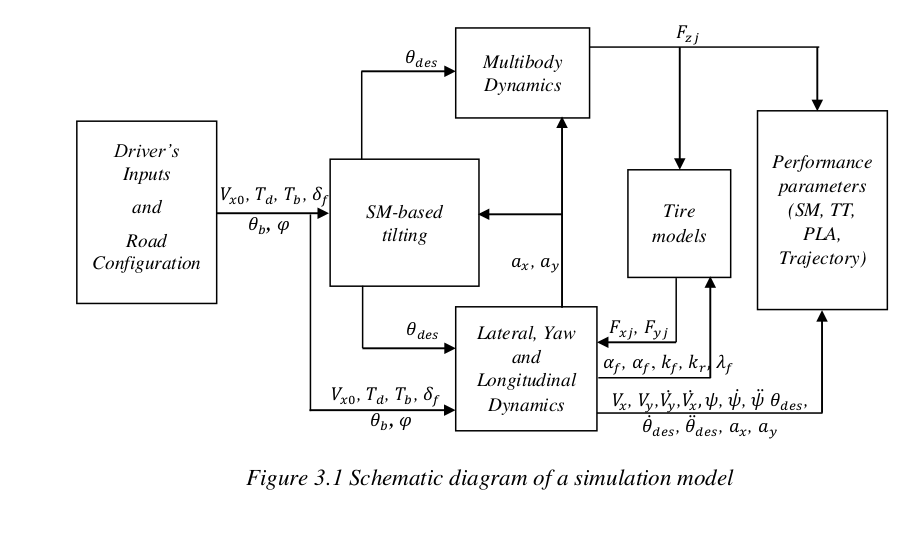
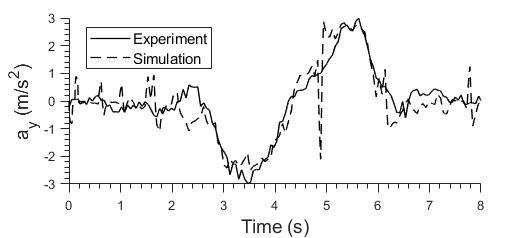
An integrated vehicle dynamics model combining longitudinal, lateral, yaw, vertical and tilting dynamics, coupled with the multibody representation and tyre models. The simulation framework was evaluated against experimental vehicle data, including measured and simulated lateral acceleration and trajectory during lane-change tests.
Schematic diagram of the integrated vehicle dynamics simulation model. Ph.D. thesis, IIT Kharagpur.Measured versus simulated lateral acceleration. Ph.D. thesis, IIT Kharagpur.
Rollover index for delta three-wheelers
Ph.D., IIT Kharagpur
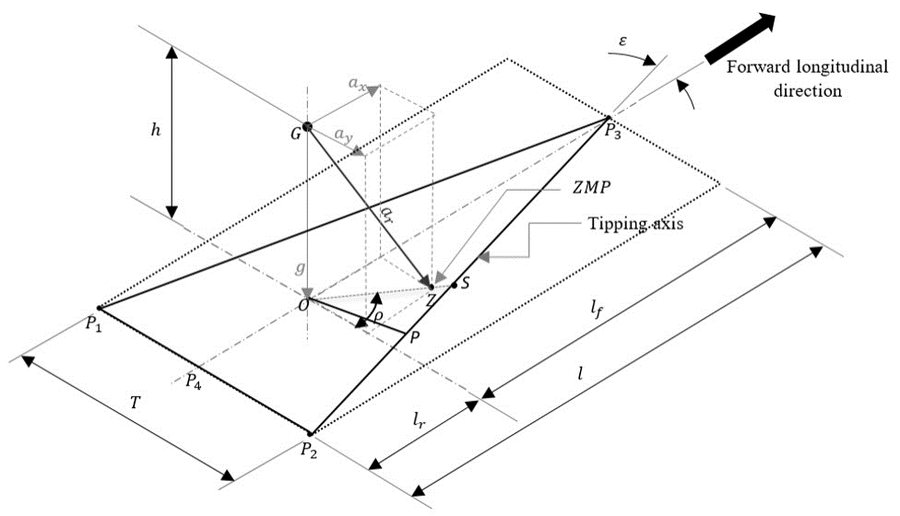
I derived a Stability Margin (SM) index for delta three-wheelers, covering longitudinal and lateral dynamics and inclined tipping axes, and included road bank and grade. I compared it with the standard Load Transfer Ratio (LTR).
Under pure longitudinal force, the LTR-based safety index never leaves its safe value, so it misses braking and traction effects. SM captures them.
SM is the basis for tilting only when the vehicle needs it.
Stability Margin from the zero-moment point and the three tipping axes. Ph.D. thesis, IIT Kharagpur.
Optimal tilt envelope and integrated steering–tilt control, with a neural-network controller
Ph.D., IIT Kharagpur
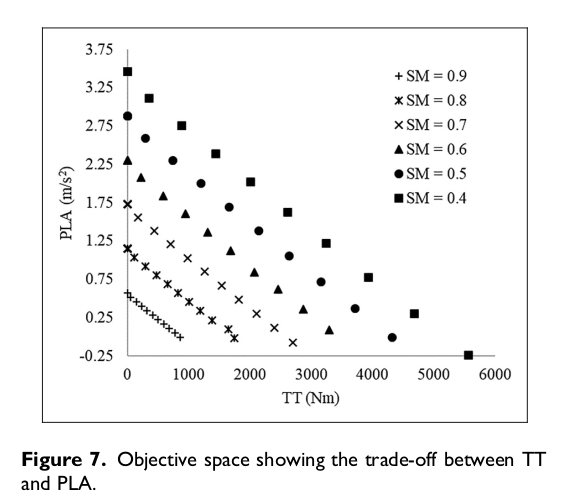
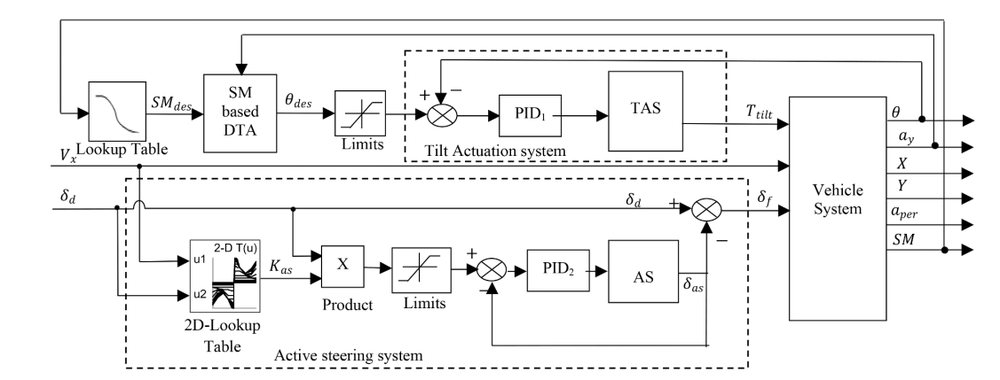
The tilt actuator activates only when SM falls below a threshold. I optimised that threshold with multi-objective goal programming across tilting torque and perceived lateral acceleration, giving a tilt-angle envelope over vehicle speed and steering angle. A counter-steering gain, optimised for minimum trajectory deviation, is combined with the tilt control.
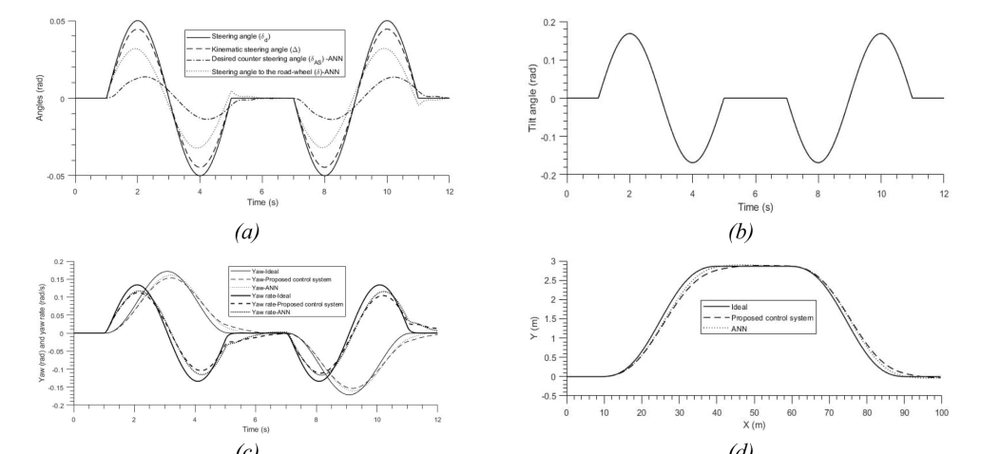
In simulation, keeps manoeuvrability and rollover stability up to 100 km/h with 22° steering input, even at the tilt limit.
Actuator models identified from experiments, with PID loops checked by frequency response, then MIL and SIL verification.
Road-bank compensation study (simulation): average tilt angle about 40% lower, perceived lateral acceleration 21% lower, and the rollover-safe lateral slope raised from 26.7° to 37.7°.
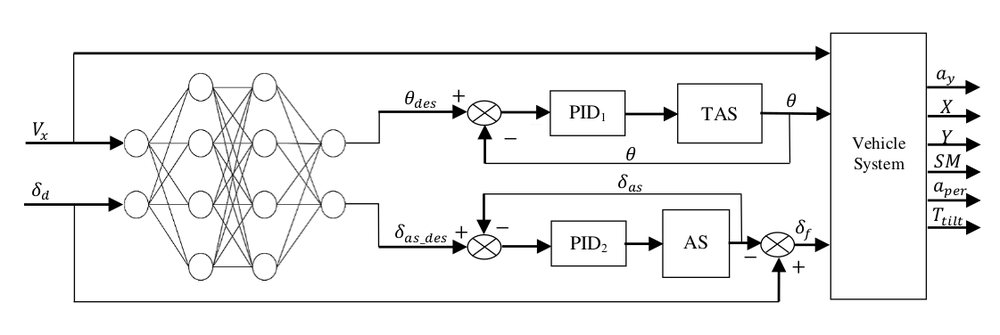
A feedforward neural network trained on the controller output replaces the control computation and responds faster; the trained network reaches R² above 0.985.
Trade-off between tilting torque and perceived lateral acceleration. Ph.D. thesis, IIT Kharagpur.Integrated steering–tilt control architecture. Ph.D. thesis, IIT Kharagpur.Neural network in the control architecture. Ph.D. thesis, IIT Kharagpur.Yaw and trajectory: ideal, proposed control and neural network. Ph.D. thesis, IIT Kharagpur.Prototype parked on a banked surface. Ph.D. thesis, IIT Kharagpur.
Coming soon
LPV-MPC for trajectory tracking of a four-wheel vehicle.
ROS/Gazebo simulation model of the delta tilting three-wheeler.
C++17 Vehicle Dynamics Framework: Developing a modular C++17 four-wheel vehicle dynamics framework incorporating longitudinal, lateral, yaw, and vertical dynamics, Pacejka tyre modelling, and vehicle roll and pitch behaviour for vehicle dynamics, control, and rollover analysis.
ROS1/Gazebo Vehicle Simulation: Developing a vehicle simulation model using component mesh files, incorporating the geometric and inertial properties of vehicle parts to represent the physical vehicle in Gazebo. Working towards integrating the vehicle representation with physics-based dynamics and actuator models.
Learning-Based Vehicle Model Correction: Developed Python-based machine-learning models using experimental vehicle data to learn and correct the error in simulated vehicle position (X, Y) and heading, with the trained models achieving an R² above 0.99.
Vehicle Parameter Estimation and Stability Metrics: Developed offline and real-time parameter-estimation workflows using analytical formulations and experimental data. Derived Load Transfer Ratio and Stability Margin metrics incorporating load-transfer physics, sprung-mass roll and pitch, suspension kinematics, and road-slope effects.
System Identification and Control: Identified steering and braking actuator dynamics using experimental data and C++ implementations. Applied signal filtering, tuned control parameters, and evaluated PID and Model Predictive Control (MPC) approaches.
Autonomous Vehicle Systems Development: Leading the conceptualisation and development of mechanical systems and subsystems for autonomous vehicle platforms, including an OEM-facing proof-of-concept. Responsibilities include CAD, design reviews, FEA, DFMEA, fabrication supervision, system integration, and vehicle-level testing.
Double-Wishbone Suspension Kinematics Software: Developed a custom suspension kinematics tool to calculate linkage motion under heave, droop, steer, and roll conditions, with 3D visualisation of component movement.
Suspension Multibody Modelling: Developed a MATLAB Simscape Multibody model of a double-wishbone suspension assembly, including control arms, upright/knuckle, tie rod, spring, and coilover.
Vehicle Dynamics and Handling Studies: Studied the influence of suspension characteristics and roll dynamics on vehicle handling and stability, including understeer, oversteer, cornering behaviour, and rollover, through engineering studies, literature review, and technical discussions with the vehicle development team.
Suspension Design and Ride Analysis: Evaluated suspension hard points using camber, toe, roll-centre migration, track change, scrub radius, and motion ratios. Developed quarter-car and half-car models for ride studies, including coilover optimisation, ride-height and rake evaluation, and sprung-mass natural-frequency analysis.
Vehicle Control and System Design: Developed Scilab-based PID and genetic-algorithm methods for an EV speed-limit algorithm, contributed to drive-mode selection through MATLAB modelling, designed an anti-roll bar to achieve desired understeer characteristics within packaging constraints and strength of anti-roll bar, and worked on hydraulic braking actuation kinematics for an unmanned ground vehicle.
Jul 2018 – Dec 2023
Ph.D. research, Indian Institute of Technology Kharagpur
Multibody Dynamics Modelling and Simulation: Gained familiarity with MSC ADAMS and CarSim; selected MATLAB Simscape Multibody for doctoral research to develop a customised 10-DoF multibody model of an actively tilting electric three-wheeler using CAD geometry, joints, sensors, and actuators, including its distinctive tilting mechanism.
Vehicle Dynamics Modelling and Experimental Validation: Developed an integrated simulation framework coupling longitudinal, lateral, yaw, and tilting dynamics with Pacejka tyre models and multibody-based wheel vertical-load estimation in MATLAB/Simulink. Validated using lane-change manoeuvres, achieving over 90% correlation with measured lateral acceleration and vehicle trajectory.
Rollover Stability Assessment and Optimisation: Proposed Stability Margin (SM) as a rollover-safety index for narrow delta three-wheelers, accounting for longitudinal and lateral dynamics and inclined tipping axes. Evaluated it against conventional Load Transfer Ratio (LTR) under road slopes and combined manoeuvres. Developed an SM-based desired tilt-angle framework and multi-objective optimisation balancing rollover safety, tilting torque, and passenger-perceived lateral acceleration.
Vehicle Control, System Identification and Simulation Testing: Developed integrated active tilt–steering control, identified hydraulic tilt and electric steering actuator models, and designed PID controllers. Evaluated closed-loop stability through frequency-response analysis and performed MIL verification, automatic code generation, and SIL testing using MATLAB/Simulink.
Learning-Based Active Rollover Control: Developed an ANN-based active rollover-control approach using Python and MATLAB, achieving R² > 0.985 and improving trajectory-following performance.
2010 – 2011, 2013 – 2018
Earlier career: Assistant Professor and Lecturer, various institutions
Taught undergraduate and postgraduate courses and laboratories in control systems and mechanics; supervised three M.E. dissertations and three undergraduate research projects, contributing to four publications.